Actuated-tip devices · srmc_abah2024
Robotic microcatheter
Self-steering robotic microcatheter (series-elastic, two bending segments)
 1 / 5
- Family
- Actuated-tip devices (actuated-device)
- Devices
- own notched-nitinol catheter: outer tube OD 1.2 mm / ID 0.95 mm, intermediate 0.89/0.725, inner 0.66 OD with 0.475 mm bore (S8 check of abah2024 Sec. IV-A); roughly 3.6 Fr at maximum OD (1.2 mm / 0.333, my conversion)
- Degrees of freedom
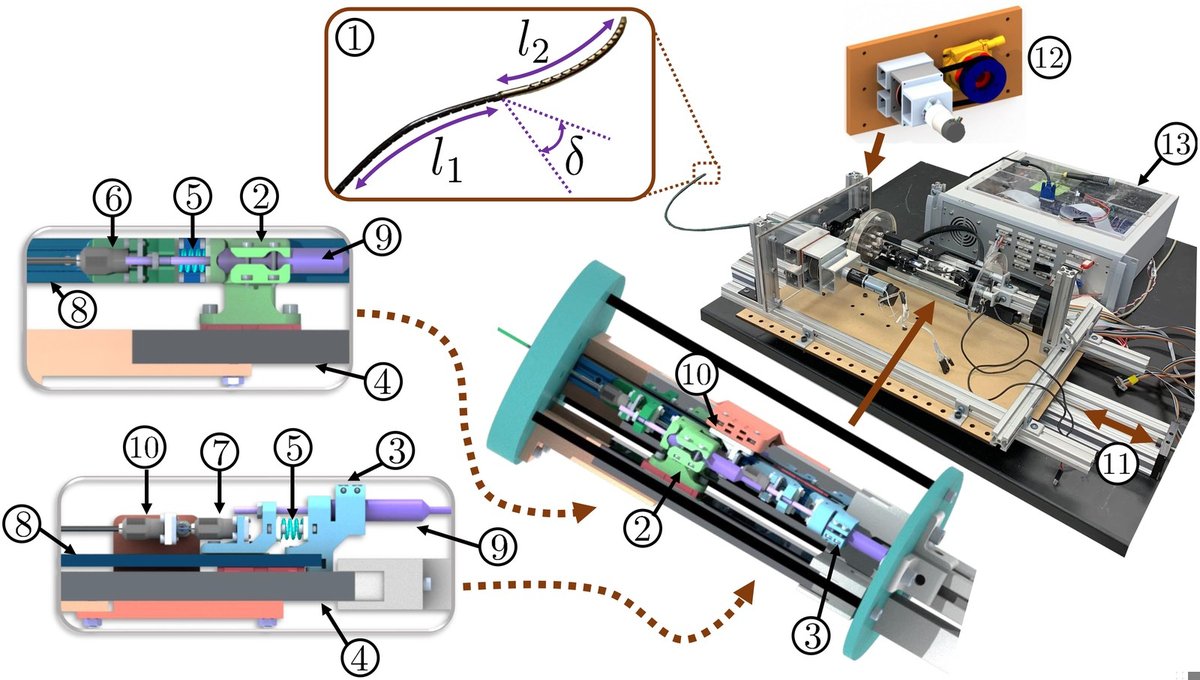
- 4 (insertion, roll, proximal bend, distal bend; bending in two separate planes)
- Push
- Tip-actuated
- Twist
- Rotating drive unit
- Tested up to
- Phantom
- Sim-to-real
- Model-based only — Commands computed in a simulator or from a physical model ran on the robot; nothing was learned.
Testing
- Highest level
- Phantom
- What was tested
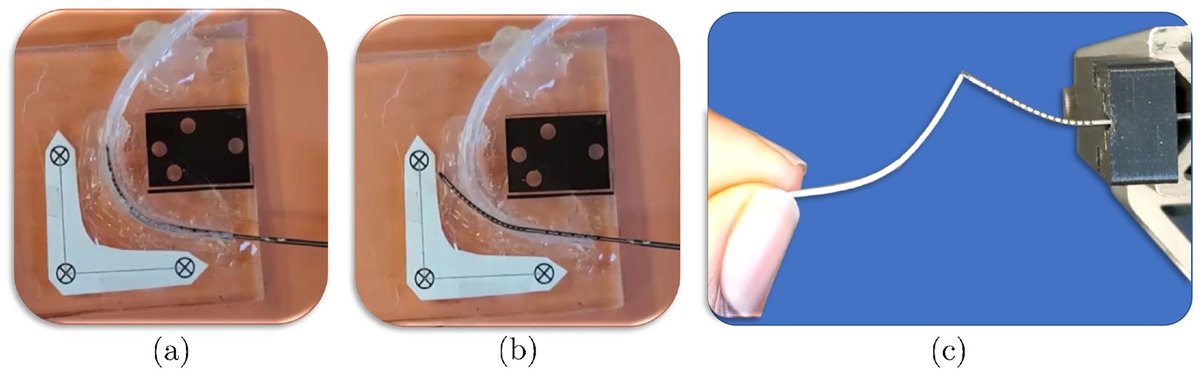
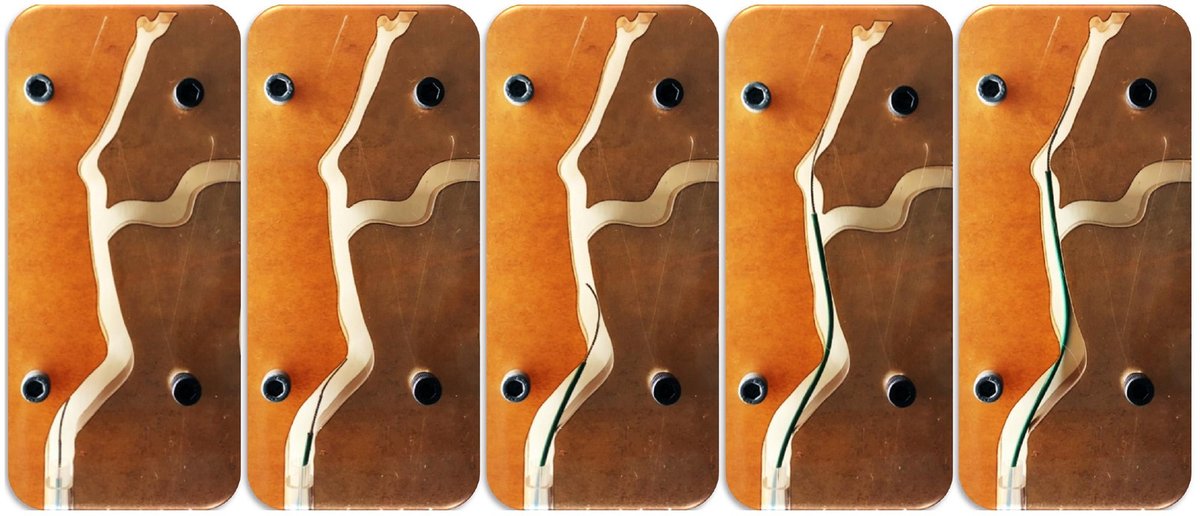
- 2D vasculature model: branch selection left and right, insertion into unknown channel under active compliance, one autonomous deployment along 2D ICA path; no success counts
- Key numbers
- distal segment OD about 0.88-1.2 mm (text differs, see S8 note); compliance trigger 0.01 N; autonomous insertion errors larger than simulated because passive extension floats between actuation unit and phantom entry
Mechanism
- Push (translation)
- tendon/tip-actuation
- Twist (rotation)
- custom actuation unit roll DoF
- Device range
- N.R.
- Target anatomy
- neuroendovascular (ICA path, 2D vasculature models)
Sensing and interface
- Force sensing
- joint-level load sensing via series-elastic actuation; active compliance triggers at 0.01 N tip force (about 1 g)
- Leader and haptics
- no
- Imaging
- bi-plane fluoroscopy for tracking (Fig. 11); catheter tracking and pose filtering algorithms
- Sterility
- N.R.
Size
- Footprint (mm)
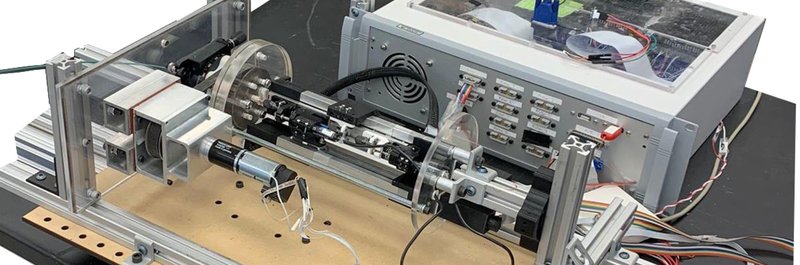
- N.R. (benchtop actuation unit on aluminium extrusion frame, Fig. 3)
- Mass (kg)
- N.R.
Simulation
- Simulation model
- kinematic model with calibration and simulated path following along 2D ICA (Fig. 8) (abah2024 Sec. V, full)
- Sim-trained controller
- model-based: planner configurations computed in simulation were run on the hardware; hardware position errors exceeded simulated errors (abah2024 Sec. V-C, full); no learned policy
Versions
- Lineage
- single (2024 T-MRB); path planner in companion paper (ref [45] in abah2024, not read)
Sources
- Self-Steering Catheters for Neuroendovascular Interventions · IEEE Transactions on Medical Robotics and Bionics, 2024 · doi:10.1109/tmrb.2024.3464123 [abah2024_self]
Notes
- Notes
- Sized for microcatheter range, the smallest actuated-tip multi-DOF catheter among the read rows. Uses the CC BY-NC-ND statement printed on the author manuscript.
This record
- Read level
- full
- Picture
- abah2024_self Fig. 1 (photo of the 4-DOF actuation unit) ↗ — licence: CC BY-NC-ND 4.0 (PMC12245187 author manuscript; edits mean internal use only); grade A
- Picture changes
- native extract (4110 px figure); cropped to the photo; one brown arrow on the wooden base and a 6 px arrow tip erased (LaMa)
- Found by
- actuated-tip: Search of actuated-tip and magnetic devices.
- Data
- JSON · YAML:
records/robots/srmc_abah2024.yaml - Correction
- Suggest a correction [repository not created yet]