Academic bedside robots · legobot_gao2026
LegoBot
 1 / 9
- Family
- Academic bedside robots (academic)
- Devices
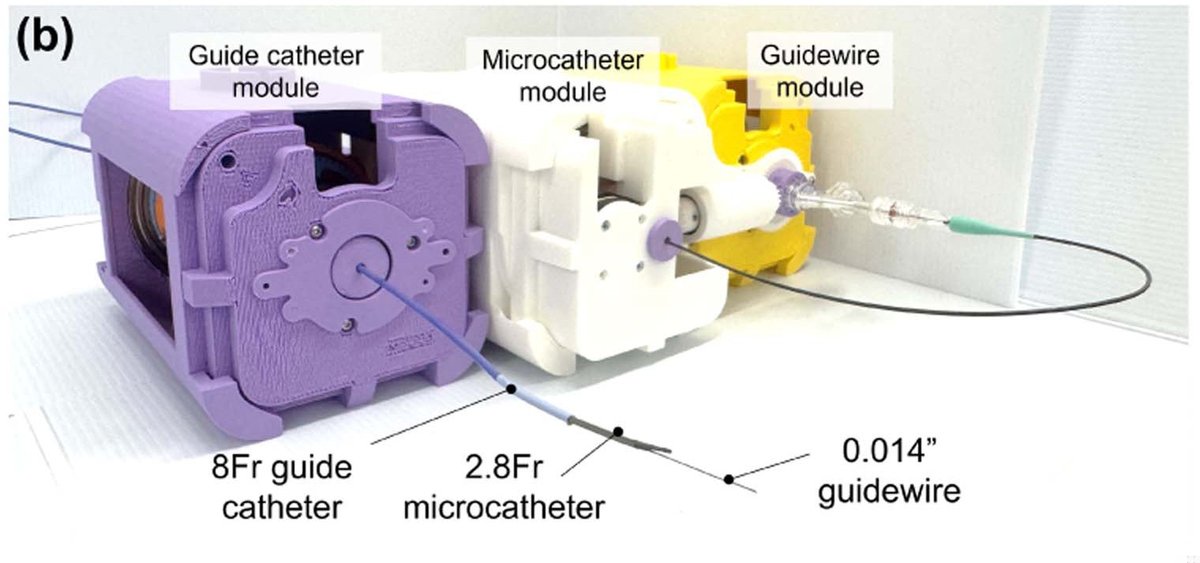
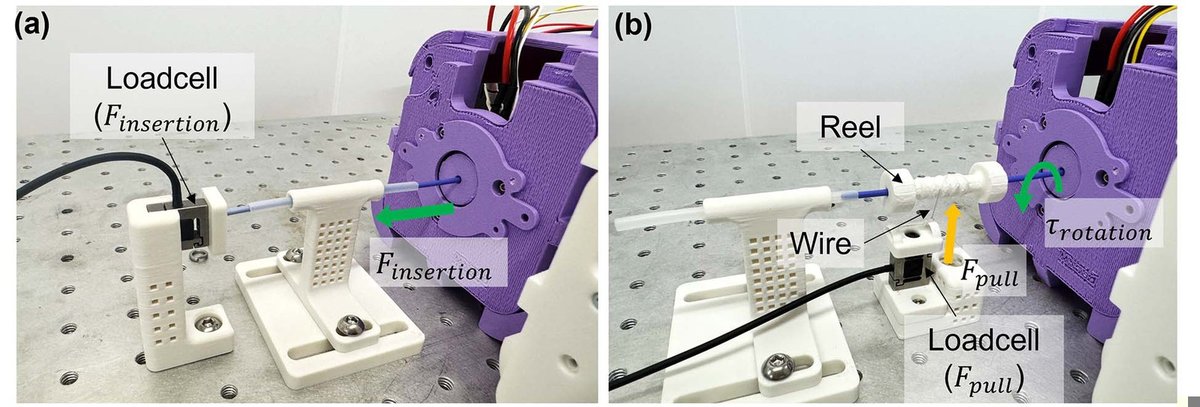
- guidewire 0.014 in; 2.8 Fr/0.028 in microcatheter; 5 Fr angiographic catheter; 6 Fr aspiration catheter; 8 Fr guide catheter (five off-the-shelf devices tested for buckling load)
- Degrees of freedom
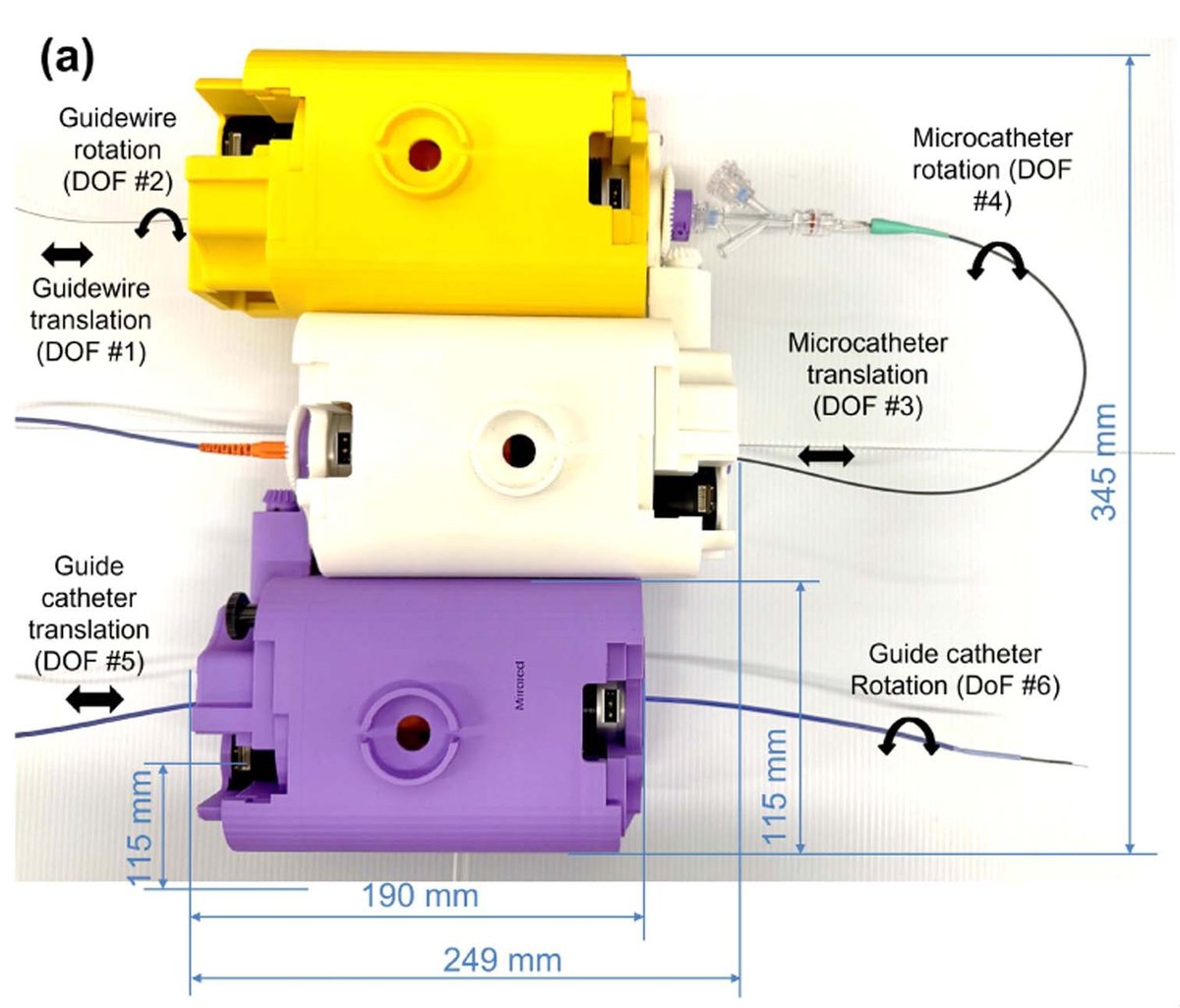
- 2 per module; 4 (two modules) or 6 (three modules)
- Push
- Friction rollers
- Twist
- Rotating clamp
- Tested up to
- Phantom
- Sim-to-real
- None found — No simulation-trained controller found for this robot.
3D model
Drag to orbit, scroll to zoom. Each module has a rotation (°) and an insertion (mm) slider; insertion moves that module's device (guide catheter teal, inner catheter dark, guidewire grey). Joint values are tube outputs, not motor angles; slider ranges are display ranges (the URDF's limits are placeholders). Replay: the joint values commanded in a recorded SOFA run (69.6 s, 524 steps, scene/setups/thrombectomy_tmech.yaml), at 4× speed. Meshes decimated from the CAD: 192,152 triangles, 3.5 MB.
Model source and kinematics
51-legobot-ros2/description/urdf/legobot.urdf and description/meshes/ (the ROS 2 / RViz digital twin with the CAD housings; generated from the CAD by 70-legobot-simulation/scripts/build_urdf_modules.py). Joint values are tube outputs, not motor angles (70-legobot-simulation/KINEMATICS.md): per module rot = 0.26667 x motor rot, ins = 0.032 m/rad x (motor ins - motor rot). Devices are nested: the guide catheter's insertion is upper_ins, the inner catheter's upper_ins + middle_ins, the guidewire's upper_ins + middle_ins + lower_ins. The URDF's joint limits are placeholders; the slider ranges are display ranges. Lab and collaborator material (BIRO Lab, New York University); CAD not released — internal build only.
Testing
- Highest level
- Phantom
- What was tested
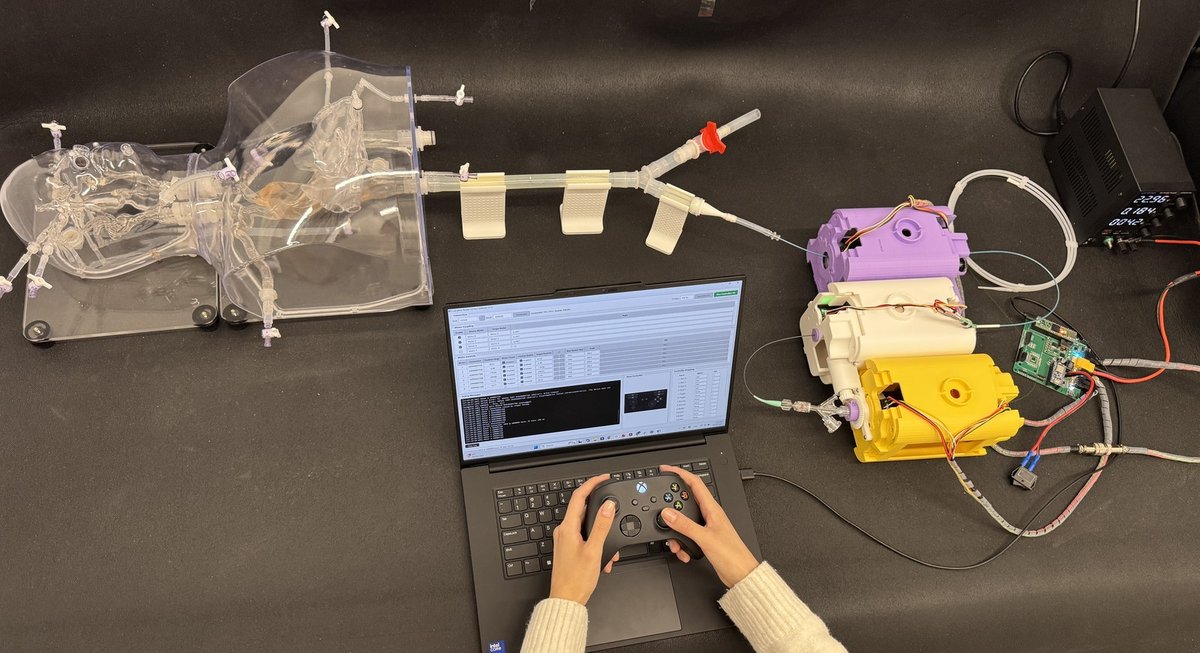
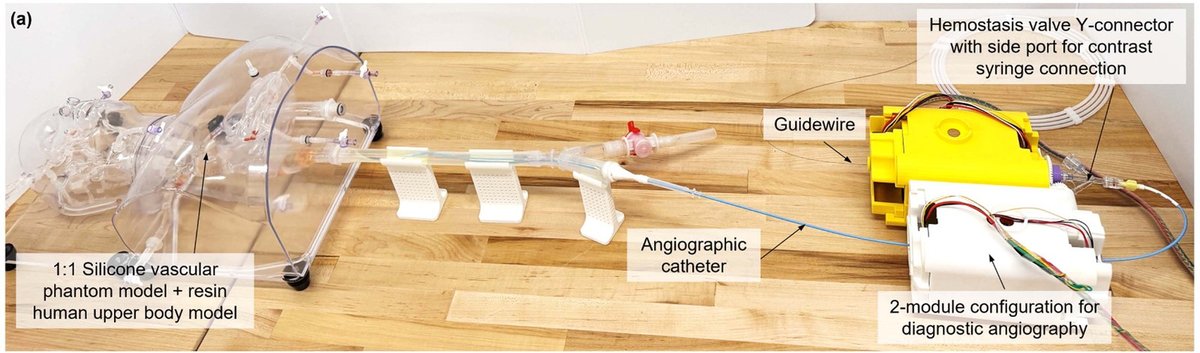
- benchtop: 8 Fr catheter slip test; buckling-load test with 5 devices; silicone neurovascular phantom (Type III arch): angiography with 2 modules and aspiration thrombectomy with 3 modules (clot aspirated); one demonstration each, repeat counts N.R.; one timed module exchange 1 min 50 s
- Key numbers
- peak insertion force 5.3 N and torque 8.4 mN.m (8 Fr) vs requirement 4.5 N / 8 mN.m; buckling load 0.1 N (0.014 in wire) to 4.3 N (8 Fr); coupler: 5 full microcatheter rotations vs ~180 deg without; 500 Hz command loop; 345x249x115 mm for 3 instruments vs 360x250x250 mm (2 instruments) of Kantu per Table I
Mechanism
- Push (translation)
- friction-roller
- Twist (rotation)
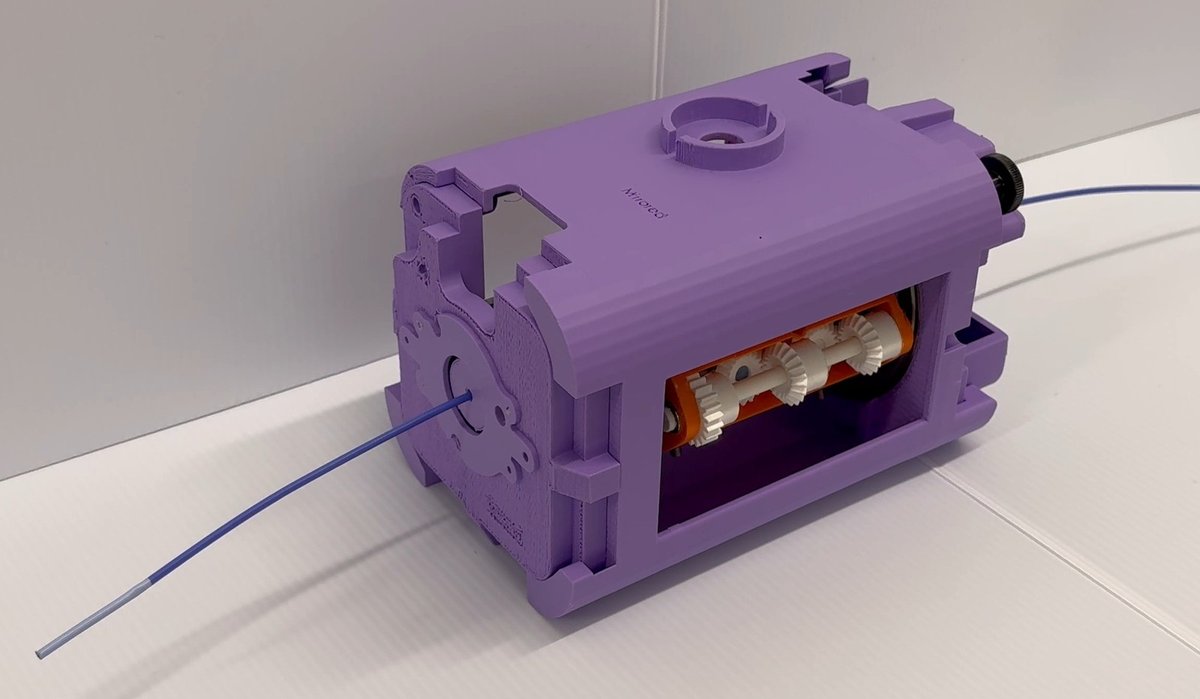
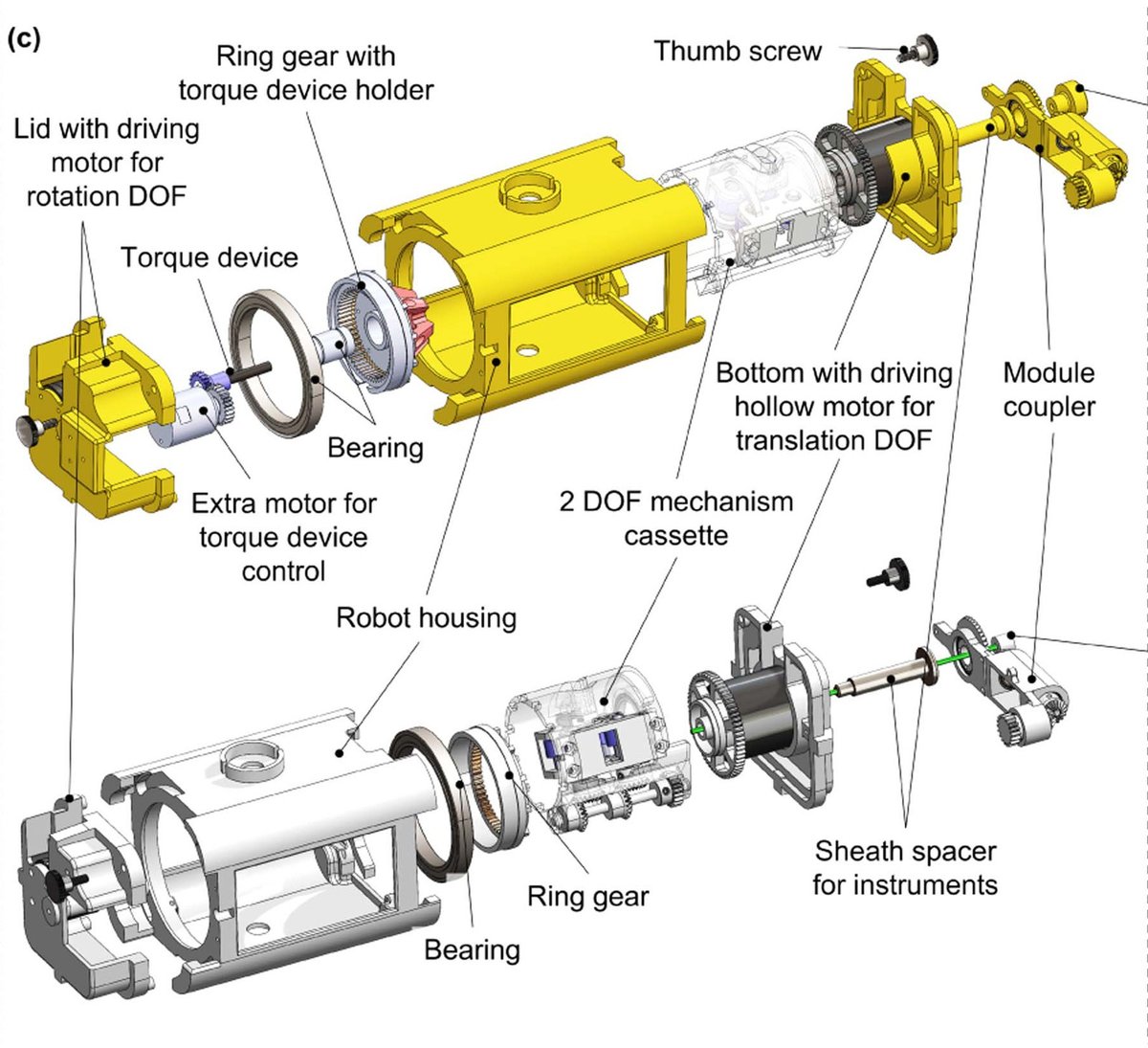
- clamped-wheel rotation: hollow-shaft direct-drive motor (0.9 N.m peak) turns the clamped instrument; module coupler adds a second torque input via bevel gears; decoupled from translation by command compensation
- Device range
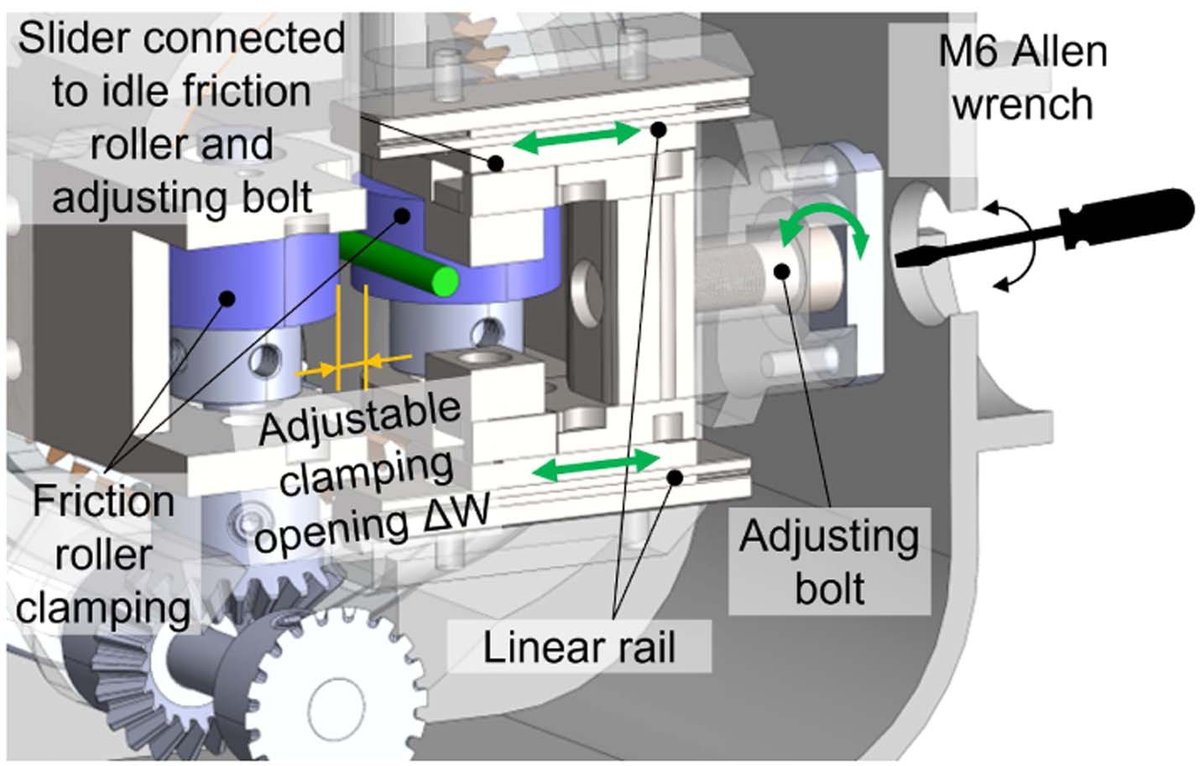
- 0.33-3 mm (adjustable clamp)
- Target anatomy
- neurovascular (diagnostic angiography, aspiration thrombectomy); coronary and peripheral stated as applicable
Sensing and interface
- Force sensing
- motor side only (current, dual 17-bit encoders); no direct instrument sensing (stated limitation)
- Leader and haptics
- none; Xbox gamepad teleoperation; haptic feedback not yet implemented
- Imaging
- N.R. (not tested)
- Sterility
- not validated (stated future work); preloaded replaceable modules; standard Luer lock / Y-connector interfaces
Size
- Footprint (mm)
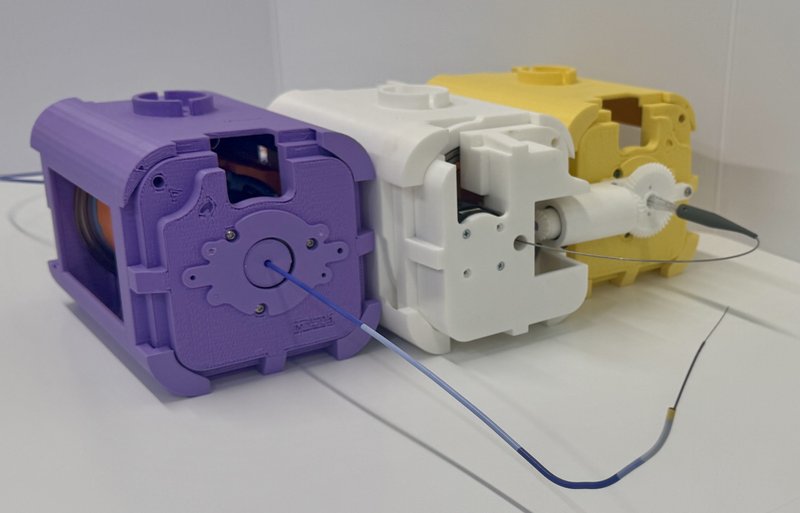
- 345 x 249 x 115 (three modules, Fig. 6a); module 190 mm wide
- Mass (kg)
- N.R.
Simulation
- Simulation model
- none found
- Sim-trained controller
- none found
Versions
- Lineage
- 2026 modular 2-DOF module; 2-module (4-DOF) and 3-module (6-DOF) assemblies
Sources
- LegoBot: Modular, compact, device-agnostic robot for endovascular catheter and guidewire manipulation in stroke thrombectomy · IEEE/ASME Transactions on Mechatronics, 2026 · doi:10.1109/TMECH.2026.3695773 [gao2026_legobot]
Notes
- Notes
- Table I (gao2026_legobot) compares with CorPath GRX, LIBERTY, Magellan, R-One, ICL, KAIST, BIT and Kantu. Table I lists Kantu at 360x250x250 mm; the Kantu abstract says 250x350x250 mm.
This record
- Read level
- full
- Picture
- BIRO Lab, New York University (own photograph) — licence: lab own (BIRO Lab, New York University); grade A
- Found by
- academic: Search of academic bedside robots.
- Data
- JSON · YAML:
records/robots/legobot_gao2026.yaml - Correction
- Suggest a correction [repository not created yet]